RAG Reranking Explained: Evaluation and Production Trade-Offs
Learn how to operate a RAG reranking stage: candidate depth, truncation, deduplication, score thresholds, evaluation, deployment, latency, and failure handling.
RAG reranking is a second-stage retrieval step that reorders a small candidate set before the language model receives context.
The basic pipeline is:
query -> fast retrieval (top 50) -> reranker (top 5) -> LLMThe first retriever searches the whole corpus efficiently. The reranker spends more computation comparing the query with only the retrieved candidates. Its job is not to discover new documents. Its job is to move the most useful evidence upward and push plausible-but-wrong chunks out of the final prompt.
This distinction matters. If the answer-bearing chunk is missing from the first 50 candidates, reranking cannot rescue it. If that chunk is present at rank 18 but the application sends only the first five chunks to the LLM, reranking may be exactly the right fix.
This guide focuses on operating the reranking stage: where it belongs, how many candidates it should receive, what it should return, how to handle truncation and duplicates, how to evaluate it, and how to deploy it within a latency budget. For model architecture and implementation, read dual encoders vs cross-encoders. For the surrounding system, begin with the production RAG architecture guide.
What Is Reranking in RAG?
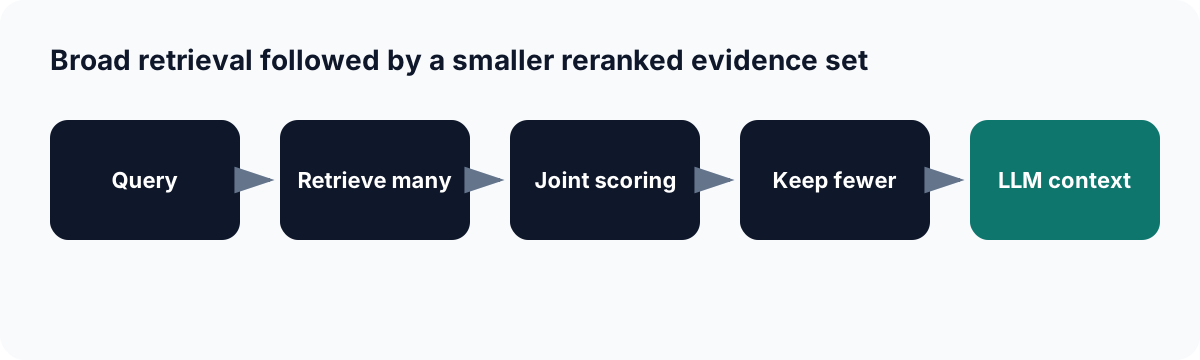
Reranking spends more computation on a limited candidate set before evidence enters the model context.
Reranking means scoring an existing list of retrieved chunks again with a model designed for finer relevance judgments.
Suppose vector search returns these results for the query Can contractors export customer data?:
1. How customers export account data
2. Contractor access-control policy
3. Data retention for former contractors
4. Export restrictions for external contractors  <- answer
5. Customer data-processing agreement
The list is semantically reasonable, but the best evidence is fourth. A reranker reads the query with each candidate and may produce:
1. Export restrictions for external contractors  <- answer
2. Contractor access-control policy
3. How customers export account data
4. Customer data-processing agreement
5. Data retention for former contractors
The candidate set has not changed. The ordering has.
This two-stage pattern exists because retrieval systems have competing goals:
- First-stage retrieval optimizes coverage and speed. It must search thousands or millions of chunks.
- Reranking optimizes precision near the top. It can use a slower model because it sees only tens of candidates.
- Context selection optimizes the final evidence set. It limits prompt noise, duplication, latency, and token cost.
Sentence Transformers' retrieve-and-rerank documentation describes the same pattern: an efficient retriever generates candidates, then a cross-encoder improves their final ranking.
Retrieval Failure or Ranking Failure?
Before adding a reranker, identify which failure you have.
Retrieval failure
The required evidence is not present in the candidate set.
Relevant chunk rank: not in top 50
Recall@50: failed
A reranker cannot score a chunk it never receives. Improve:
- Chunk boundaries and document parsing
- Query rewriting or expansion
- Embedding model and index settings
- Metadata filters
- Candidate depth
- Keyword coverage with hybrid search
Ranking failure
The evidence is present, but it appears below irrelevant or less useful chunks.
Relevant chunk rank before reranking: 17
Relevant chunk rank after reranking: 2
Recall@50: unchanged
MRR and Precision@5: improved
That is the problem reranking is built to solve.
Inspect the rank of the first answer-bearing chunk before changing the pipeline. Low candidate recall is a retrieval problem. Good candidate recall with poor top-k precision is a reranking opportunity.
What the Reranker Does in This Pipeline
A reranker receives a bounded candidate set and assigns new relevance scores before final context selection. Cross-encoders are a common implementation, but this article treats the model as an operational component rather than explaining its internal architecture.
The RAG responsibilities are to supply authorized candidates, control input length, batch requests, enforce timeouts, calibrate thresholds, remove duplicate evidence, and select the final context. The model comparison, joint-attention mechanics, ColBERT's late interaction, named reranking models, and implementation code are owned by dual encoders vs cross-encoders.
Where Reranking Fits After Hybrid Search
Hybrid search and reranking solve different problems.
Hybrid search combines complementary ways to find candidates:
BM25 top 50 -------\
                    RRF top 60 -> reranker top 6 -> LLM
vector top 50 -----/
BM25 protects exact terms such as identifiers, error codes, API names, and versions. Dense retrieval finds paraphrases and conceptual matches. Reciprocal Rank Fusion combines the two rankings without pretending their raw scores share a scale. The reranker then performs a deeper query-candidate comparison.
Fusion improves candidate coverage. Reranking improves final order. Learn the complete fusion workflow in Hybrid Search for RAG Explained.
Candidate Depth and Final Top-K
Two numbers control the reranking stage:
- Candidate depth: how many retrieved chunks the reranker receives
- Final top-k: how many reranked chunks survive for context selection
These values should not be identical. Retrieving only the five chunks you plan to send to the LLM gives the reranker almost no opportunity to correct the first-stage order.
A practical evaluation grid is:
| Reranker candidates | Final chunks | What it tests |
|---|---|---|
| 20 | 3 | Fast, narrow precision baseline |
| 40 | 5 | Balanced starting configuration |
| 80 | 5 | Whether deeper candidates improve recall |
| 80 | 8 | Whether more context helps multi-part questions |
Do not treat 40 and 5 as universal defaults. Test them against your corpus and traffic.
Candidate depth creates a quality-cost curve:
too shallow -> relevant evidence excluded before reranking
large enough -> evidence included and reordered successfully
too deep -> higher latency, cost, noise, and truncation risk
Measure Recall@candidate-k before reranking. If recall stops improving between 40 and 80 candidates, the larger window may not justify its cost. If recall continues to improve but reranking latency becomes unacceptable, improve first-stage retrieval so relevant evidence appears earlier.
Truncation: the Hidden Reranking Failure
Rerankers have input limits. When the query and candidate exceed that limit, the implementation may truncate part of the candidate.
Imagine a long chunk structured as:
Title and navigation
General policy introduction
Definitions
Exceptions
Answer-bearing sentence near the end  <- truncated
The model cannot rank evidence it never reads. This often looks like a model-quality problem when it is really an ingestion or input-format problem.
To reduce truncation failures:
- Use coherent chunks sized for both embedding and reranking models
- Put titles, section headings, and important metadata next to the chunk text
- Remove navigation, boilerplate, and repeated footers
- Log token counts and truncation rates
- Test queries whose answer appears near chunk boundaries
- Use a long-context reranker only if evaluation shows the extra context helps
Read how to choose chunk size for RAG before compensating for broken chunks with a larger model.
Deduplication and Evidence Diversity
A relevance reranker may place four overlapping chunks from one document in the top five. Each chunk is individually relevant, but together they waste context and can hide another source needed for the answer.
Use a post-reranking selection stage:
def select_diverse(results, limit=5, max_per_document=2):
    selected = []
    per_document = {}

    for result in results:
        document_id = result["document_id"]
        count = per_document.get(document_id, 0)

        if count >= max_per_document:
            continue

        if overlaps_selected_evidence(result, selected):
            continue

        selected.append(result)
        per_document[document_id] = count + 1

        if len(selected) == limit:
            break

    return selected
For single-fact questions, one highly relevant passage may be enough. For comparisons and multi-hop questions, diversity across entities or documents becomes part of relevance. Evaluate these query types separately.
Reranking Scores and Thresholds
Reranking scores are model outputs, not universal probabilities.
A score of 0.7 from one model is not necessarily comparable to 0.7 from another model, another version, or another domain. Even within one model, the useful threshold depends on your candidates and tolerance for unsupported answers.
Use scores in three ways:
- Ordering: sort candidates by score.
- Filtering: remove weak candidates using a threshold calibrated on labeled queries.
- Abstention: if no candidate passes the threshold, tell the generation layer that the corpus may not contain an answer.
Do not copy a threshold from a tutorial. Plot score distributions for relevant and irrelevant candidates in your own evaluation set. Recalibrate whenever you change the reranker, chunking, corpus, or first-stage retriever.
How to Evaluate a RAG Reranker
Evaluate retrieval and generation separately. Otherwise, an LLM may produce a plausible answer from prior knowledge and hide a weak retrieval pipeline.
Build a labeled query set
For every query, record:
- Relevant chunk IDs or documents
- The minimum evidence needed to answer
- Query type: factual, identifier, comparison, multi-hop, or unanswerable
- Required access-control and metadata filters
- Expected answer and supporting citations
Include hard negatives: chunks that share the vocabulary and topic but do not answer the question. These examples reveal whether the reranker understands fine distinctions rather than broad similarity.
Run an ablation
Keep the corpus, queries, filters, and generation settings fixed.
| Configuration | Recall@50 | MRR | nDCG@5 | Context precision | P95 latency |
|---|---|---|---|---|---|
| Retriever only | Measure | Measure | Measure | Measure | Measure |
| Retriever + reranker | Should remain stable | Compare | Compare | Compare | Compare |
| Hybrid + reranker | Compare | Compare | Compare | Compare | Compare |
Important metrics include:
- Recall@candidate-k: did the retriever supply the required evidence?
- Mean Reciprocal Rank: how early does the first relevant result appear?
- nDCG@k: does the top of the list contain highly relevant results in the right order?
- Precision@k or context precision: how much selected context is useful?
- Duplicate rate: how much context repeats the same evidence?
- Answer faithfulness and citation accuracy: does generation remain grounded?
- Latency, throughput, and cost: is the improvement operationally acceptable?
Sentence Transformers provides a CrossEncoderRerankingEvaluator with reranking metrics including MRR. For an end-to-end testing strategy, continue with RAG evaluation engineering.
Read the metrics in the correct order
If Recall@50 is low, fix retrieval first.
If Recall@50 is good but MRR, nDCG@5, or context precision is weak, test a reranker.
If retrieval metrics improve but answer quality does not, inspect prompt construction, context order, conflicting evidence, and the generator. The bottleneck has moved downstream.
Hosted or Self-Hosted Reranking?
Choose deployment based on data policy, traffic, and operating capability.
| Decision | Hosted API | Self-hosted model |
|---|---|---|
| Setup | Fast | Requires serving infrastructure |
| Scaling | Provider-managed | Your responsibility |
| Data path | Leaves your environment unless private deployment is available | Can remain in your network |
| Cost pattern | Per request or token | Compute and operations |
| Model control | Limited to provider options | Full version and optimization control |
| Latency tuning | Network plus provider inference | Hardware, batching, and quantization under your control |
Hosted reranking is useful for quickly establishing whether the stage improves quality. Self-hosting becomes attractive when privacy, predictable high volume, offline operation, or model customization dominates.
Benchmark with your candidate lengths and concurrency. A model that looks fast on ten short passages may behave differently on 80 long technical chunks.
Production Failure Modes
Reranking too few candidates
If the relevant result is usually ranked 30 to 50, reranking only the first ten cannot help. Measure candidate recall at several depths.
Sending every high-scoring chunk to the LLM
More relevant text is not automatically better context. Control duplicates, contradictions, and total tokens.
Applying permissions after reranking
Authorization filters must run before any model sees candidates. Post-filtering can also leave too few results and distort evaluation.
Treating relevance as answer sufficiency
A chunk can be topically relevant without containing the fact needed to answer. Label answer-bearing evidence, not merely related documents.
Ignoring document freshness
A reranker may prefer an older policy because its wording matches the query more closely. Apply effective-date rules or incorporate freshness explicitly.
Changing the retriever without retesting the reranker
The first-stage retriever determines the reranker's candidate distribution. Switching embeddings, hybrid weights, or chunking changes the hard negatives it sees.
No timeout fallback
A remote reranking failure should not necessarily fail the entire request. Define whether the system returns first-stage results, retries, or abstains.
When Reranking Is Worth It
Reranking is a strong candidate when:
- Relevant chunks often appear in the candidate set but below the final cutoff
- The corpus contains many near-duplicate or closely related passages
- Questions depend on negation, conditions, relationships, or versions
- Incorrect context has a high product or business cost
- Hybrid retrieval improves recall but produces a noisy fused order
Skip or postpone it when:
- The corpus is small enough for a simpler search method
- The top results are already precise on representative queries
- Latency is strict and reranking provides no measured downstream gain
- Candidate recall is poor
- Broken parsing or chunking is the actual bottleneck
For a wider failure diagnosis, see why RAG systems fail.
A Practical Starting Experiment
Use this sequence as an experiment, not a universal configuration:
1. Freeze a representative labeled query set.
2. Record the retriever-only baseline.
3. Retrieve 40 candidates per query.
4. Rerank those candidates with one fixed reranker configuration.
5. Select the top 5 after deduplication.
6. Compare Recall@40, MRR, nDCG@5, context precision, and latency.
7. Repeat with 20 and 80 candidates.
8. Test final context sizes of 3, 5, and 8.
9. Evaluate answer faithfulness and citation accuracy.
10. Ship only if the held-out improvement justifies the cost.
Then analyze results by query type. Reranking may create a large improvement for policy exceptions and version-specific questions while doing little for direct keyword lookups. That breakdown is more useful than one overall average.
The Bottom Line
RAG reranking is not another retrieval system. It is a precision layer between broad candidate retrieval and narrow context selection.
The durable rules are:
- A reranker cannot recover missing candidates
- More expensive relevance scoring must justify its added latency and cost
- Candidate depth and final top-k solve different problems
- Truncation and duplicate evidence can erase the expected gain
- Scores and thresholds must be calibrated on your data
- Retrieval metrics should improve before you credit reranking for better answers
Start by checking candidate recall. If the evidence is present but poorly ordered, reranking is a focused, testable improvement. If the evidence is absent, repair retrieval first.
Next, place reranking inside the full RAG architecture, or combine it with hybrid search for RAG when your queries need both exact and semantic matching.
Sources
Frequently Asked Questions
What is reranking in RAG?
Reranking is a second-stage retrieval step that takes a limited set of candidates returned by a fast retriever and scores them again with a more precise model. The reranker reorders those candidates so the most relevant, answer-bearing chunks are more likely to enter the language model's context. It cannot recover a relevant chunk that the first-stage retriever never found.
Why use a reranker after vector search?
Use a reranker when candidate recall is acceptable but relevant chunks rank below the final context cutoff or irrelevant chunks occupy the available context. The reranker can improve ordering within the supplied candidate set, but it cannot recover evidence that the first-stage retriever did not return.
How many documents should a RAG reranker process?
There is no universal number. A practical experiment is to rerank 20, 40, and 80 candidates and select 3, 5, or 8 final chunks. Measure candidate recall, nDCG or MRR, context precision, latency, and cost for each configuration. The reranker needs enough candidates to contain the evidence, but expanding the window adds compute and can introduce truncation or noise.
What is the difference between hybrid search and reranking?
Hybrid search expands and fuses candidates from complementary retrievers such as BM25 and vector search. Reranking applies a more expensive relevance model to the resulting candidate set and changes its order. A common pipeline is BM25 plus dense retrieval, RRF fusion, reranking, then final context selection.
Which metrics should I use to evaluate a RAG reranker?
Measure Recall at candidate-k before reranking to verify that the evidence is available. Measure MRR, nDCG at k, Precision at k, context precision, and duplicate rate after reranking to evaluate ordering. Then measure answer faithfulness, citation correctness, task success, latency, and cost. Compare retriever-only and retriever-plus-reranker configurations on the same frozen query set.
When should I skip reranking in RAG?
Skip or defer reranking when the corpus is tiny, the retriever already places clean evidence at the top, latency is extremely constrained, or the relevant chunk is absent from the candidate pool. In the last case, fix indexing, chunking, query transformation, filters, or first-stage retrieval instead. Reranking is an ordering tool, not a substitute for recall.
Follow on Google
Add as a preferred source in Search & Discover
Add as preferred source
Krunal Kanojiya
Technical Content Writer
Krunal is a technical content writer at Lucent Innovation and a former full-stack developer with professional technology experience since 2021. He publishes source-backed, practical guides on AI engineering, RAG, vector search, data engineering, algorithms, and software development.